What is abdominoplasty?

For some women after pregnancy, diet and exercise alone may not be enough to address the changes to the abdominal muscles and skin that occurred during pregnancy. The separation of the abdominal muscles (known as a ‘divarication’) can lead to back pain or discomfort due to loss of core stability, contribute to pelvic floor issues, and leave persistent loose skin and a rounded belly that can be mistaken for another pregnancy. This can be very disheartening.

Abdominoplasty can help repair the muscle separation and remove the excess skin.

This procedure may be suitable for you if you’re in good health and have a separation of the rectus abdominus muscles (the ‘six pack’ muscles) and/or significant excess skin.

If the surgery is following pregnancy, you should have completed your family and your youngest child should be over 12 months old.

It’s important to understand that abdominoplasty is not a weight loss procedure.

The best results and lowest complication rates occur in women who are in a healthy weight range.

Abdominoplasty is performed under general anaesthetic in a hospital setting.

The procedure involves making an incision in a crease in the lower abdomen to access the abdominal wall muscle layer. The dissection extends up to just below the sternum (chest bone). The gap in the muscles is repaired with heavy gauge sutures and the excess skin and fat is then removed, leaving a tightened abdominal wall and smoother contour. There is a new hole made for the belly button and that is sutured back into place. At the end of the procedure 2 drains are placed, these remain for 5-10 days, and the wounds are repaired with dissolvable stitches. There is a simple glue dressing covering the wounds which allows showering and no need for dressing changes. This is in place for 2-3 weeks. Dr O’Mahony then fits a binder to support the repair. This is worn for 6 weeks day and night.

Dr O’Mahony will discuss all aspects of the procedure with you during your consultation.

Recovery varies depending on the extent of the procedure.

Most ladies will spend 2-3 nights in hospital. You will have drains still in place for discharge and the nurses will teach you how to manage these. It is very simple. My nurse Chris will remove these in my office in the first 1-2 weeks after surgery.

Depending on your type of work you may need between 3 and 6 weeks off, depending if you can work from home or have a physical job.

You will be unable to drive a car for 4-6 weeks as the muscle repair limits your comfort in twisting your upper body freely and quickly undertaking defensive manoeuvres.

Sport and exercise is limited for the first few weeks. Gentle arm weights could be restarted at 3 weeks, walking can resume from about 4 weeks, along with physio guided pilates to retrain your ‘core’ muscles. All forms of exercise can resume at 6 weeks, building back up gradually.

Dr O’Mahony will discuss what to expect during your consultation and provide detailed recovery instructions.
During pregnancy, all layers of the abdominal wall stretch, but particularly the rectus abdominus muscles (the ‘six pack’ muscles) that run up and down the centre of your abdomen.

This separation is called a ‘divarication’.

With time and targeted exercises, this separation can sometimes be reduced, but in many women – particularly those with large or multiple pregnancies or a short torso – the stretch has been so significant that the separation cannot be fully corrected without surgery.

Abdominoplasty is usually planned at the completion of your family. Happy ‘accidents’ do occur however, and your abdominal wall will stretch to accommodate another pregnancy. If your surgery was for weight loss and you are planning future pregnancies Dr O’Mahony may vary the type of sutures she uses to tighten the muscle layer of the abdomen if that is required. In both scenarios there may be a need to re-repair your muscles after subsequent pregnancies however.

Medicare recognises Abdominoplasty surgery to repair the muscle separation and skin excess after pregnancy as a reconstructive procedure under certain criteria. These include a rectus divarication of a least 3cm measured by imaging such as ultrasound, pain or discomfort at the site of the muscle separation, lower back pain or urinary symptoms and failed non-surgical treatment such as physiotherapy. In addition, 12 months must have passed since your last pregnancy.

Abdominoplasty after large weight loss is also recognised by Medicare in certain circumstances. Dr O’Mahony can advise you of your eligibility after examining you.

Dr O’Mahony’s office will provide a written quote for surgery following your consultation which will include any relevant Medicare Item Number. You will need to confirm with your own health fund if the relevant Medicare item numbers are included on your policy. If so your Health Fund should contribute to the rebates and your hospital stay.

If you are considering Abdominoplasty Surgery and would like to consult with Dr O’Mahony please contact the office for an appointment on 3831 6983.

Questions?
If you would like more information or arrange a consultation with Dr. O’Mahony, please contact us for an appointment

Our approach to your care

Dr O’Mahony understands that considering abdominoplasty can feel like a significant decision.

She maintains a welcoming, caring atmosphere and will take the time to ensure you feel completely informed and comfortable.

She believes it’s important for you to have sufficient time to make an informed decision, and she’ll consult with you as many times as you need before proceeding with surgery.

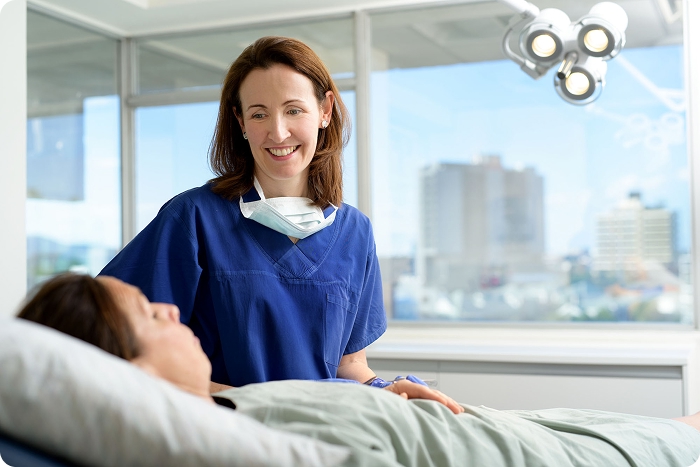
Dr Susan Checking on a patient